Hi everybody.
I was going to make this post one about my latest artwork. A comment at the end of my last post, changed my mind. My friend Chris (Hi Chris!) said, "Excellent - more please." It's so nice to know that my posts are appreciated. I decided that as Chris had asked so nicely, I would create a post dedicated to him. See Chris? If you don't ask, you never get!
Comments on images in this blog, will be added where I think they are needed.
Off we go with the first image:
The two photographs below, are of a Broad-bodied Chaser dragonfly. A very handsom species.
Length: 3.9-4.8cm
Can be seen in summer around ponds, lakes and gardens.
Conservation status = common and can be seen from May to August.
Because these insects require
stable oxygen levels and clean water, scientists consider them reliable
bioindicators of the health of an ecosystem.
Each Dragonfly patrols and defends it's own area of water, which can be quite a large patch. After a patrol searching for insects, they tend to return to the same perch each time. When I saw this one land, I had a good idea that it was it's regular resting place. I was right. I concealed myself as well as I could and waited for it to return from it's next patrol. The images below are the result. The backgrounds are different, because I had to change my position. It landed a few inches away from the place it had settled when I took the first shot.
Broad-bodied Chaser preening
Broad-bodied Chaser again
The following photo is of two Northern Damselflies mating. The position they use for this is termed "The Wheel". The male is blue, the female is yellow-green. There are several Damselflies which look superficially similar. A close study of their markings helps identification. The Norther Damselfly is listed as an "Endangered Species". I'm so pleased that I found these two.
Norther Damselflies in
The Wheel position
The image below, is the last of my Dragonfly / Damselfly photos in this post. At a casual glance, it may be mistaken for a Northern Damselfly. A careful look at it, proves it to be a Varient Damselfly. The multi-coloured "diamond" shaped patch, where the wings are attached, shows it to a Varient Damselfly. This coloured area is absent in other damselflies.
The difference between Dragonflies and Damselflies is that Damselflies have wings that are both the same size and shape, which taper where they are attached to the body. Dragonflies have different shaped fore and hind wings. Their hind wings are much broader and don't taper as much where they attach to the body, giving them more of an aeroplane look.
Varient Damselfly (detail)
I'm going to stay with the insect family for a while now, them move on to birds. Do you see the connection? They are all flying creatures. It wasn't intentional, it simply happened that way. It's a case of synchronicity (unity in diversity).
On the subject of unity in diversity, below is an image showing the three variations of the "Marbled Beauty" moth. I get many of these coming to my door each year. They demonstrate a good example of excellent camouflage against the lichens on which the
eggs are laid. This species rests by day on stone walls and rocks. The intensity of the markings vary considerably, with darker individuals predominating in urban areas, it's an example of industrial melanism.
A significant proportion of individuals have orange or yellow
markings. The hindwings are whitish with a broad grey band at the
margin. There is a nioticable variety in size too. All of which confuses a poor novice to the art of mothing, as I well know! The adults fly at night, during July and August and are attracted to light.
(We have a night security light over the door, it brings a lot of moths). I look forward to them starting to arrive each year. For reasons I don't understand, I'm very fond of them.

Three Marbled Beauties
Now for another fairly regular annual visitor to our front door, the White Ermine moth. It flies from May to July and sometimes later, in the south. The number of black spots on the wings,varies greatly from largely white examples,
which are almost entirely plain, to those with many more spots that may join together to form streaks along the wing veins. The white wing colour can also vary with creamy-buff or even the brown examples often found in Scotland.
Many moths, but not all, are sexualy dimorphic, meaning that the male and females differ in appearance. For example, many female moths are wingless. They climb to the bottom of tree trunks to attract males. Male moths possess antennae, these can detect female pheromones upto two miles away.
White Ermine (male showing anennae)
This post is turning into a long one. I don't wish to bore any readers, so I will just add the butterfly photos without comments. I can hear sighs of relief accross cyberspace. :-)
From moths we move to the other branch of Lepidoptera;
- Butterflies have thread-like antennae that are thickened or knobbed at
the end.
- Skippers, (part of the butterfly group) have thread-like, knobbed antennae as well, but the
knobs are tipped with distinct hooks.
- Moth antennae may be thread-like,
feathery or spindle shaped, but lack knobs on their antennae.
So it's butterflies and then one skipper.
There are four common and widespread species
of white butterfly that are frequently seen in gardens and many other
habitats. These are the Large White, Small White, Green-veined White and
Orange-tip. First, two Small Whites mating.
Small Whites mating
Comma butterfly
Small Tortoiseshell
Red Admiral showing both top
and underside of wings
That's the end of the Lepidoptera. Next are two photos of bees.
The first one is of a bumble bee and a honey bee, meeting head on. For those who don't know, the honey bee is at the bottom of the image.They came up from opposite sides of the flower and spent a few seconds face to face. There was no aggression, they simply moved aside, to let each other passed. I can only guess what was happening, possibly exchanging where the best pollen flowers are? It was nice to watch and I got a good photo.
Bumble bee and honey bee
A different bumble bee. You can see it's proboscis, tacking up nectar.
Bumble bee showing proboscis
Staying on the theme of flying creatures, a few bird photos. These were included for Michelle at my local art shop
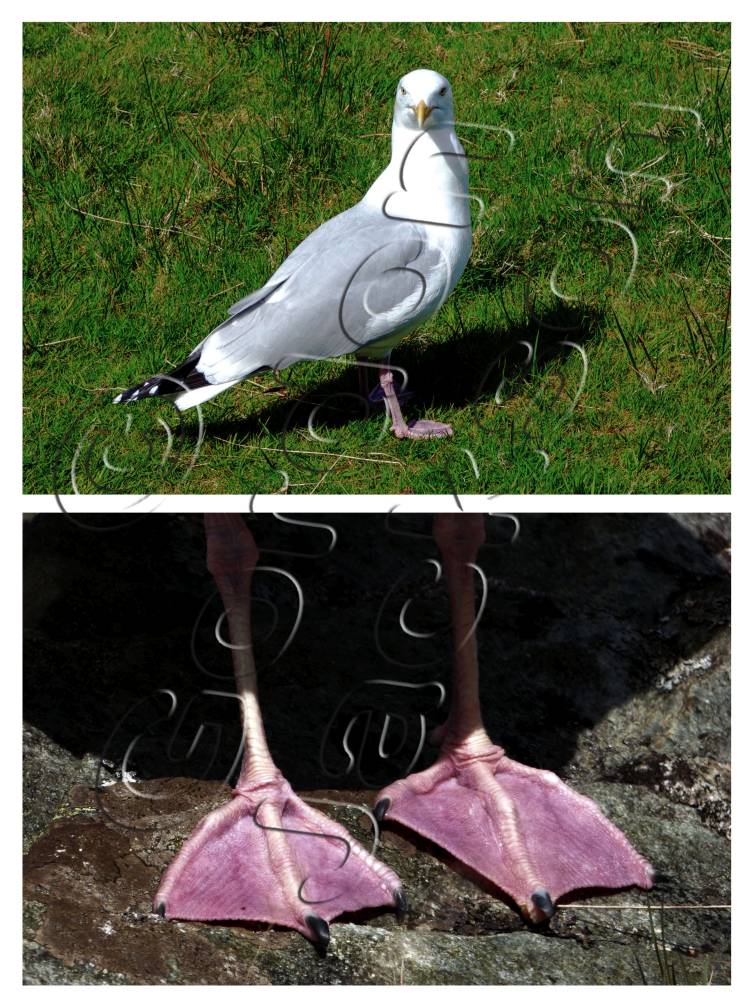
The first is a Herring gull. Anne and I were on the Isle of Arran, in a beautiful village called Lochranza. We were sat on a bench looking out across the sea, having dinner, as we watched the small inner island ferries coming and going. The gull flew to where we had thrown some bread. It watched us very carefully, in case we moved, we sat very still. As it was looking away, we threw a little food nearer to us. It stood and stared a us, we never moved. Deciding we were safe, it came closer to get the food. Then turned it's head and stared at us for what seem like a long time. VERY slowly, I lifted my camera up to take a photo, "click" perfect! It moved onto a lump of limestone and I got a wonderful photo of it's feet. It isn't something you get to see in close-up very often. I was doubly pleased with the images.
Herring gull
A Starling now. The common starling has about 12 Subspecies in temperate zones of Europe.Also, western Mongolia. It has been introduced to New Zealand, Canada, Australia, the United States, Mexico, Argentina, South Africa and Fiji. It's resident in western and southern Europe and south-western Asia. North-eastern populations migrate south and west in the winter within the breeding range and also further south to Iberia and North Africa.
As a result of it being so common, I imaging most of my readers here will have seen them. I wonder how many people look at them carefully? They have a beautiful range of metallic-sheen colours, and nice markings. They are very good mimics, I've heard one imitate a Curlew, a Trimphone (who remembers them?) and a range of other birdsong calls.
Starling
A good close-up of a Jackdaw next. We have two pairs on our street which nest every year. They are quite common in the area we live. They're handsome birds. They often pair up for life. They are renown for their intelligence and can be taught tricks.
Jackdaw
Next, we have Britain's national bird, the Robin. A lot of people think they only appear at Christmas. That's not true, they are just more visible in winter, due to the bare trees and sometimes, if we are lucky, snow. One has started to visit our garden in the last few weeks.
Robin
A House Sparrow now, we have several pairs of them on the street. They breed twice a year. It's so nice to hear the chicks calling for food. As they get bigger, they leave the nests to stand on the guttering of houses. Finally, the parents get them to fly across the street, to the opposite side. It's a big day for them.
House Sparrow
The last bird photo is of a Wood Pigeon. Again, there are several on our street, I love their song. Now and then, one sits on our roof and sings down the chimney. Who needs hifi for music, when you have that?
Wood Pigeon
The last few photographs in this blog are all fungi, which should please my friend Maura. The first one is a cluster of Sulphur Tuft's. Their status is "Common". They can be found on Rotting wood and stumps. They occur in dense clusters on the stumps of deciduous and coniferous trees.The best time to see them is June, July, August, September, October, November. It is inedible, with a very bitter taste. In Britain and Europe Sulphur Tuft (Hypholoma fasciculare) has been linked to severe cases of poisoning and most probably at least one death. Don't eat it!
Sulphur Tuft
Now for the Tar Spot fungi (Rhytisma acerinum). This is very common on the leaves of Sycamore trees, it can also affect a number of trees such as Maple and Acers. The fungus does not harm the tree as such. When the infected leaves fall off, they are broken down in harmlessly by the soil. When the the Industrial Revolution in Britain was in full swing, Tar Spot virtually disappeared, it returned when the Clean Air law was passed. Sulphur dioxide from burning coal was acting as a disinfectant, killing the Tar Spot. It' isn't very often that pollution has a beneficial role to play!
Tar Spot on sycamore leaf
and a close-up of one "spot"
The photo below is not one of my best ones. I was pushing the resolution of my lens. Still, it captures the effect of the Nettle Rust fungi, on the underside of a nettle leaf. The yellow "daisies" are fruiting bodies which release the sporse. There are quite a few species of Rust fungi. Each one has it's own prefered plant. Sad man that I am, I'm making a collection of rust fungi. I always have a camera with me.
The strikingly colourful fungus below is a Scarlet Waxcap. Waxcaps in general are incredible. There is wide variety of brightly coloured ones. As the name suggests, many species of Waxcaps have slippery caps. The Slimy Waxcap, is a grey to brown colour. They're hard to handle or keep hold of. I knew that by reputation. I didn't really believe, it until someone asked me to look at what he'd found. It was very shiny. He told me to take it from him. It shot straight out of my hand, I had two or three goes at picking it up. It's amazing.
Scarlet Waxcap
The last image of this post is below. It's a Scarlet Elfcup fungus. It is reasonably widespread, but not very common. It's mostly found in damp, shady areas. on fallen Hazel, Elm and Willow twigs. It's often buried under moss. They can be found from January to April. The cup size ranges from 1 to 5 cm. The one in the photo was a little over 1 cm. It had been partially eaten by insects but I felt it made it more interesting. In Zen Buddhist terms, it increased it's Zen. It's shape reminds me of modern ceramic bowls. This fungus got it's name because it used to be thought that Elves drank dew from them. Isn't that nice?
Scarlet Elfcup
That's the end of this blog post. I hope you enjoyed it Chris and I hope that many of you in cyberland liked it too. My next post will be of my latest artworks.
Be nice to each other.
Gordon.


%20Arctiidae_orb.jpg)